




Children's dentist in DarmstadtThe dentist? Can we go again tomorrow?
At the first appointment we do not treat. We look, we count, we ride the chair, and your child gets to touch everything that will later go into their mouth. Dentist Saskia Bondick sees children from the very first milk tooth – calmly, at eye level and with no surprises.
Mon–Thu 8 am–6 pm · Fri 8 am–5 pm · Dieburger Straße 10, Darmstadt
How old is your child? Here is what comes next.
Four age groups, four answers. Each one has its own programme of check-ups.
From the first tooth
Early detection examinations FU 1 to FU 3 between the 6th and 33rd month of life. We take a look, advise on bottles, toothpaste and fluoride – and apply varnish twice a year.
Practising counting teeth
A check-up twice a year (FU PA). This is when your child gets to know the chair, the mirror and the tooth shower, while there is still nothing to be done.
Wobbly tooth years
Individual prophylaxis IP 1 to IP 5, brushing school with disclosing tablets, and sealing of the first permanent molars.
Permanent teeth
Six-monthly prophylaxis, sealing of the twelve-year molars, cleaning around braces – and an eye on the wisdom teeth.


Getting acquainted: five steps, none of which hurt.
The first appointment is not a treatment appointment. It takes about half an hour and it is guaranteed to end with something good. A child who meets the dentist while nothing hurts has no reason to be afraid later on.
Arriving
A play corner in the waiting area, books, wooden blocks. Your child may take their time. Nobody calls them in too early.

Saying hello
We crouch down rather than lifting your child up. A short chat: nursery, school, favourite animal. Only then do we talk about teeth.
Riding the chair
The chair is the first toy: up, down, light on. With the youngest we stay in the knee-to-knee position, on mum's or dad's lap.

Counting teeth
The mirror and the air blower are tried out on the back of the hand first, then in the mouth. We count out loud. Nothing more happens the first time.
Collecting the certificate
At the end there is the certificate – no matter how much worked out. Courage is what gets rewarded, not perfection.

“We never do anything we have not announced beforehand.”
That is the one sentence that matters. A child who has been caught out once will not believe a word the next time. So we announce every step – and we stop when we say we will stop.
First tell, then show, then do.
Tell – show – do is the method paediatric dentistry works with worldwide. No instrument touches a tooth before your child has seen it and held it. And no word is spoken that could frighten them.
Tell
We explain in one sentence what is about to happen – in words a five-year-old knows. No jargon, no baby talk, no threats.
Show
Every instrument is demonstrated first on the back of the hand, on a fingernail or on a model. Your child may hold it, hear it and switch it on.
Do
Only then in the mouth, and only for as long as agreed beforehand. We count to ten – and at ten we stop, even if we are not finished.
Our dictionary for young ears
Tap a card. On the front is what grown-ups say. Behind it is what your child hears from us.
- “The dentist is going to count your teeth today.”
- “I will be in the room the whole time.”
- “You may ask anything you want to know.”
- “Afterwards you get your certificate.”
- “There is nothing to be afraid of.” This is what brings the word afraid into play in the first place.
- “It will not hurt at all.” Again, the only word the child hears is: hurt.
- “If you do not brush, you will need the drill.” This turns the practice into a punishment.
- “I hated it as a child too.” Children take on their parents' fear remarkably reliably.
The timetable: which tooth arrives when, and when it leaves.
Twenty milk teeth, then thirty-two permanent ones. The order is the same in almost every child; only the timing varies. Here are both timetables at a glance – to look up whenever another tooth starts wobbling at home.
The milk teeth arrive
Eruption in months of lifeAt around two and a half to three years the set of twenty milk teeth is complete.
The permanent ones arrive
Eruption in years of lifeAverage values. Half a year earlier or later is perfectly normal and no cause for concern.
The six-year molar is not a milk tooth – even though everyone thinks it is.
At six or seven a new molar breaks through right at the back, without any milk tooth falling out first. Because no wobbly tooth comes before it, many parents take it for a milk tooth that will go anyway. But it stays for life. Freshly erupted, its enamel is still soft and its chewing surface deeply grooved – which makes it the tooth most at risk of decay in the whole mouth. That is why we seal it as soon as it has fully erupted.
The timetable: what is checked and when.
For children and teenagers there is a fixed programme of check-ups – from the first early detection examination in babyhood to sealing at seventeen. Here is what is due at what age, and how often.
| Age | What happens | How often |
|---|---|---|
| 6th–9th month | FU 1 – first early detection: a look at the teeth and mouth, advice on bottles, toothpaste and fluoride | once |
| 10th–20th month | FU 2 – check-up, assessment of caries risk, brushing advice | once |
| 21st–33rd month | FU 3 – check-up, advice on diet and brushing | once |
| from the 1st tooth | Fluoride varnish – a protective coat on the tooth surface that hardens the soft enamel of milk teeth | 2 × a year |
| 3rd–6th year | FU PA – six-monthly examination at nursery age, with fluoride varnish | 2 × a year |
| 6th–18th year | IP 1, IP 2, IP 4 – individual prophylaxis: oral hygiene status with disclosing tablets, brushing school, dietary advice, fluoridation | 2 × a year |
| 6th–18th year | IP 5 – fissure sealing of the permanent molars (sixes and sevens): the deep grooves of the chewing surface are closed with resin, without drilling | once per tooth |
| 8th–10th year | A look at tooth alignment – during the change of teeth we keep an eye on whether an orthodontic assessment makes sense | at every check-up |
As of September 2026. At the end of each appointment we tell you which examination is due next and book it straight away. If you miss an appointment, we will remind you.
A hole in a milk tooth? We treat that.
“It is going to fall out anyway” is the most common mistake in paediatric dentistry – and the most expensive one. What to do about decay, about an accident, and about a child who simply will not play along.
Why milk teeth are treated
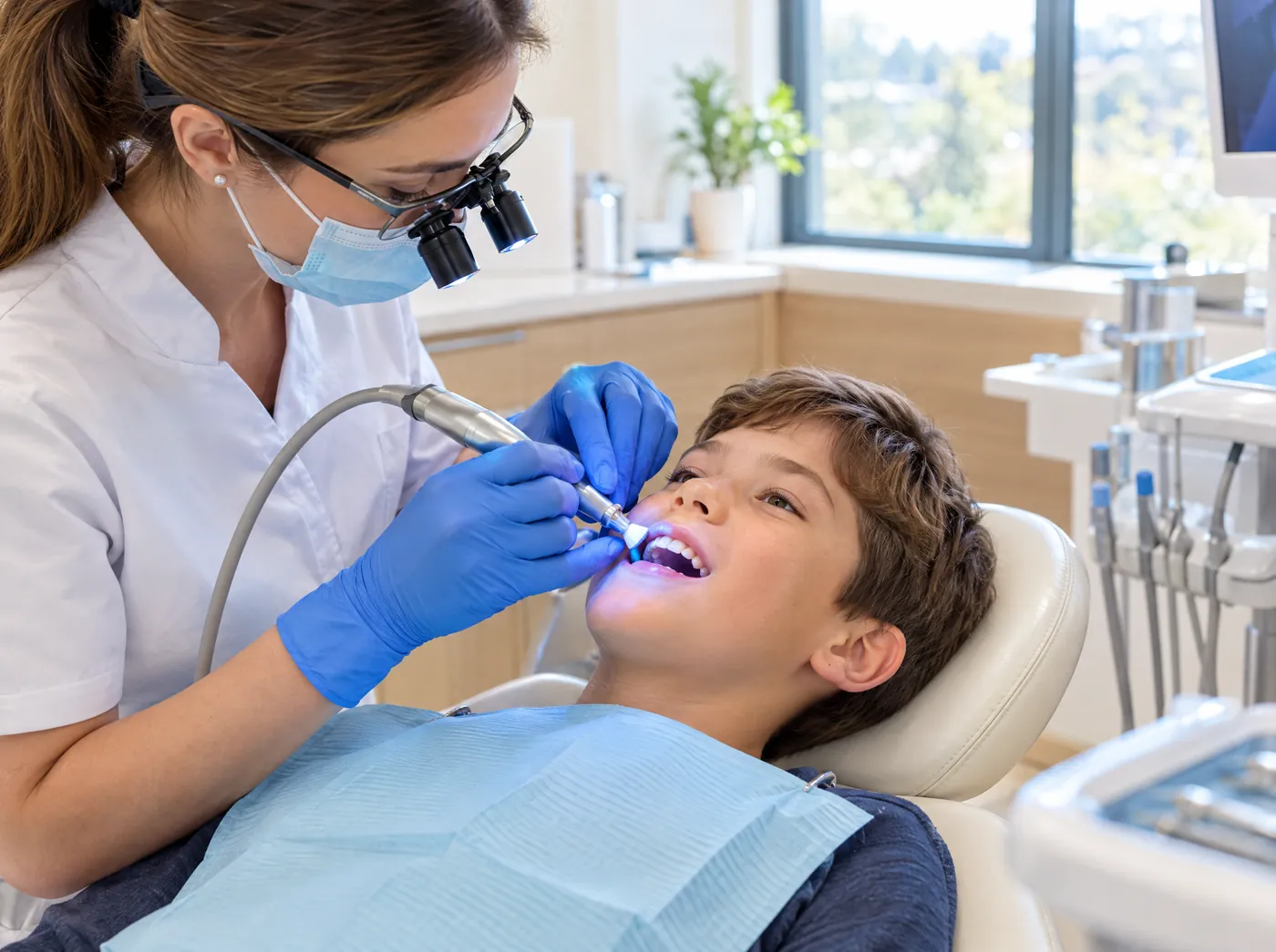
Milk teeth hold the space for the permanent teeth. If one is lost too early, the neighbouring teeth tip into the gap – and the permanent tooth no longer finds room. Many a later set of braces goes back to exactly that moment.
On top of that, the enamel of a milk tooth is only half as thick as that of a permanent tooth, so decay reaches the nerve twice as fast. And directly beneath the root lies the germ of the permanent tooth, which is being formed right there. An untreated inflammation can damage it before it has even erupted.
Tooth knocked out? The first 30 minutes count.
A fall off a scooter, a ball in the face, a jump into shallow water: a knocked-out permanent tooth can often be put back – if it is transported correctly and you get here quickly.
- 1Stay calm, stop the bleedingA clean tissue on the wound, let your child bite down on it. Cool the cheek.
- 2Hold the tooth by the crown onlyNever touch the root, do not wipe it, do not scrub it, do not disinfect it. The fine cells on the root decide whether the tooth will reattach.
- 3Keep it moistBest of all in a tooth rescue box, available at any pharmacy. Failing that cold long-life milk, at a pinch saliva or saline. Never in water and never dry.
- 4Call straight away06151 79983. We will fit you in. Outside our opening hours: the dental emergency service or the university hospital.
Milk teeth are the exception: a knocked-out milk tooth is not put back – it could damage the germ of the permanent tooth beneath it. Do bring your child in for a check anyway, so that we can examine the jaw and the neighbouring teeth.
Call now: 06151 79983And if my child will not play along at all?
Then we do nothing further that day. One forced appointment ruins five good ones after it. Instead we invite your child back for another practice run – short appointments, always the same sequence, always a small success at the end. For most children two or three such visits are enough.
When it really will not work.
With very small children, with pronounced anxiety or when there is a lot to do, we treat under general anaesthesia together with an anaesthetist. Your child sleeps, everything is done in one sitting, and the practice does not become a place of fear. That is the last step, not the first. More on treatment under general anaesthesia →

Saskia Bondick
Dentist · she looks after the children here
“Trust grows out of listening – which is why I take my time before I treat.”
Treating children is not a sideline for Ms Bondick; it is the part of her work she likes best. She explains every step before she takes it, and she takes the time a child happens to need that day – even if that means the appointment ends with one counted row of teeth and a certificate.
- since 2025Associate dentist at the Mensch im Mittelpunkt dental practice, Darmstadt
- 2025Dentalklinik Margareten, Vienna
- 2024Winner of the student competition in aesthetic dentistry, Goethe University Frankfurt
- since 2023Doctoral research in human medicine, Goethe University Frankfurt
- 2018–2024Studied dentistry, Goethe University Frankfurt
Questions parents often ask.
How old should my child be for a first dental visit?
From the first milk tooth, and at the latest between the sixth and ninth month of life. Three early detection examinations, FU 1 to FU 3, are scheduled between the 6th and the 33rd month. They are less about treatment than about advice: bottles, toothpaste, fluoride, dummies. And about your child getting to know the room, the sounds and us, while nothing hurts.
My child is afraid of the dentist. What do you do differently?
The first appointment is simply about getting acquainted, with no treatment. We work by tell-show-do: explain first, then demonstrate on a finger or a model, and only then use it in the mouth. No instrument touches a tooth before your child has seen it and held it. We say beforehand what will happen, and we stick to it. If a child has had enough on a given day, we stop and make a new appointment.
Should I come into the treatment room as a parent?
With small children, yes, very gladly. Up to about three years we examine in the knee-to-knee position, with the child lying on your lap. From nursery age onwards you are welcome to stay, but it is best to sit a little to one side, so that your child talks to us rather than through you. Some children cooperate surprisingly well without an audience – we will discuss that with you beforehand.
Do milk teeth really need treating? They fall out anyway.
Yes. Milk teeth hold the space for the permanent teeth, and they are needed for chewing and for learning to speak. Decay also travels fast in a milk tooth because the enamel is thinner, and it can damage the permanent tooth being formed beneath it. A milk tooth lost too early often leads to crowding and later to braces.
What is fissure sealing?
The chewing surfaces of the molars have fine grooves so narrow that no toothbrush bristle reaches inside. Sealing closes these grooves with a thin resin. It takes a few minutes, there is no drilling and it does not hurt. For the permanent molars, the sixes and sevens, it is provided for between the 6th and the 18th year of life.
My child has had a tooth knocked out. What should I do?
Hold the tooth by the crown only, never by the root, and do not wipe or disinfect it. Put it in a tooth rescue box if you can, otherwise in cold long-life milk, at a pinch in saliva. Then call us straight away: 06151 79983. Within the first 30 to 60 minutes the chances of saving the tooth are best. Important: a knocked-out milk tooth is not put back, because it could damage the germ of the permanent tooth – but do come in for a check all the same.
When does the first permanent tooth appear?
Usually at six or seven, and right at the back: the six-year molar breaks through behind the last milk molar, without any milk tooth falling out. That is exactly why it is so often overlooked and mistaken for a milk tooth. But it is a permanent tooth meant to last a lifetime – and one of the first candidates for sealing.
How often should my child come for a check-up?
From 3 to 6 years two examinations a year are provided for, and from 6 to 18 years individual prophylaxis every six months on top. So two appointments a year is the normal case. With a high risk of decay, ongoing orthodontic treatment or after a treatment we will see your child more often.
Do you also treat children under anaesthesia?
When treatment while awake is not sensibly possible – with very small children, with pronounced anxiety or when a great deal needs doing – we work with an anaesthetist and treat under general anaesthesia. That is always the last step, never the first. We try everything beforehand to help your child manage while awake.
When should my child see an orthodontist?
The best moment for a first orthodontic assessment is between 8 and 10 years, during the change of teeth. Some misalignments, such as a crossbite or a pronounced lack of space, are addressed earlier. We keep an eye on it at every check-up and will tell you in good time if an assessment makes sense.
Come and meet us, with no treatment at all.
Call us and tell us how old your child is and whether they have been to a dentist before. If it went badly last time, tell us that too – then we will allow more time and start again from the very beginning.
Opening hours & contact
Appointments by arrangement
Parking: REWE car park, Spilwesweg 1 – two minutes on foot.