

Single implant in DarmstadtOne tooth missing. One comes back.
A single implant replaces the root and crown of one tooth without grinding down the neighbouring teeth. Planned in 3D, placed by an implantologist with a master’s degree, explained without rush.
Mon–Thu 8 am–6 pm · Fri 8 am–5 pm · Dieburger Straße 10, Darmstadt
A single implant is usually the right choice if …
Three typical situations from our consultations. Whether it is right for you, we clarify with an examination and a 3D X-ray (CBCT/DVT).
- a single tooth is missing or can no longer be saved
- the neighbouring teeth are healthy and should stay that way
- you want a fixed solution that feels like your own tooth

What a single implant really is.
An artificial tooth root made of titanium, anchored in the jawbone. Once it has healed in, it carries the visible crown via a connecting piece. Three parts, one fixed tooth.
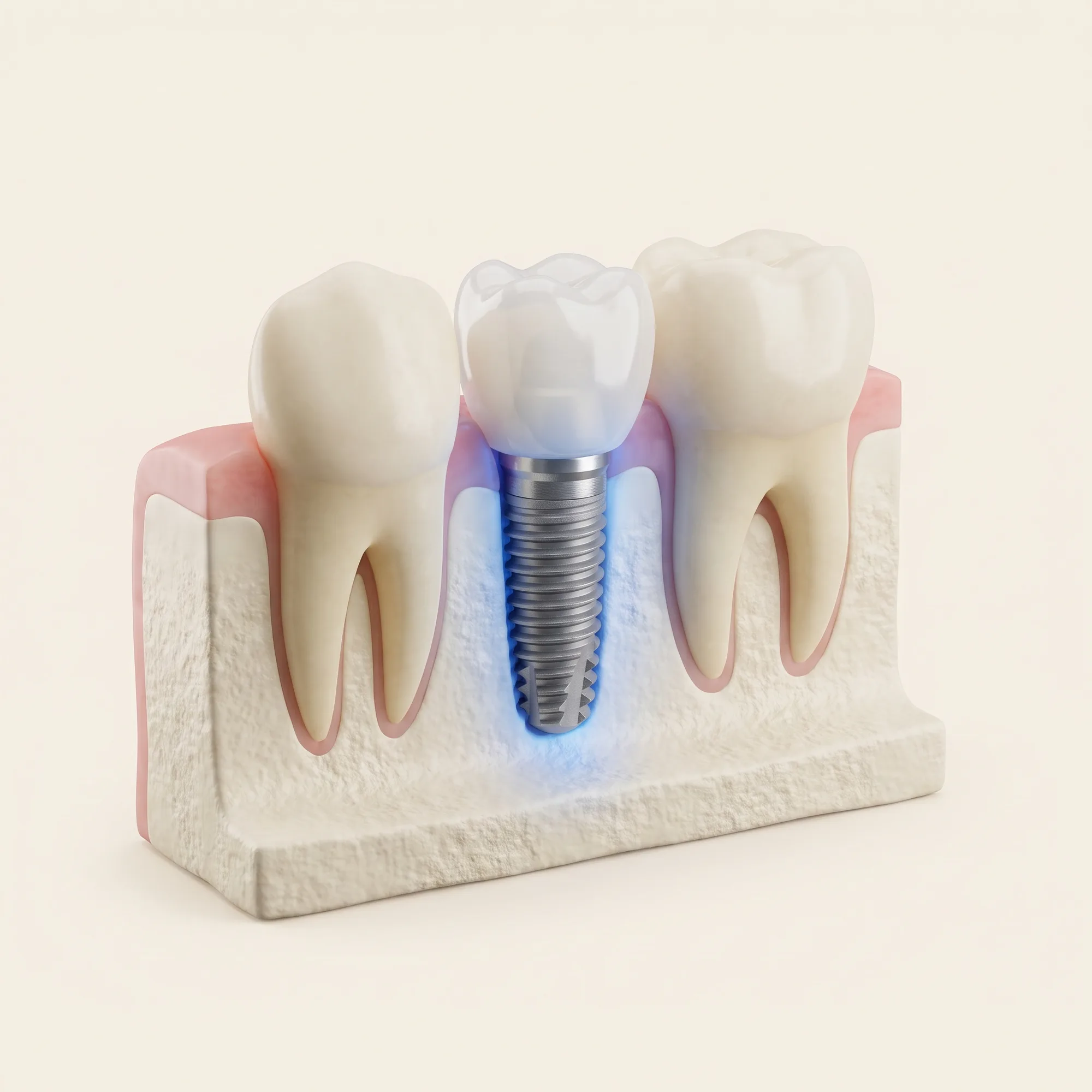
The implant
A titanium screw, 8 to 14 millimetres long. Within a few months the bone grows onto its surface. This is called osseointegration.
The abutment
The connector between root and crown. It passes through the gum and shapes it so that it later sits naturally around the tooth.
The crown
All-ceramic, digitally scanned, colour-matched to your teeth. Nobody sees the difference, not even you.
Implant or bridge: an honest comparison.
For a conventional bridge, the neighbouring teeth are ground down to serve as abutments. A single implant leaves them alone. That doesn’t mean an implant is always the better solution.
| Single implant | Conventional bridge | |
|---|---|---|
| Neighbouring teeth | Left untouched | Ground down |
| Jawbone | Preserved and kept under load | Recedes under the gap |
| Stability when eating | Like your own tooth | Firm |
| Treatment time | 3–5 months | 2–3 weeks |
| Care | Like your own teeth, plus check-ups | Floss under the bridge |
| Lifespan | Often decades | 10–15 years |
| Makes sense if | the neighbouring teeth are healthy | the neighbouring teeth need crowns anyway |
From planning to crown: five steps.
We assess the bone, gums, neighbouring teeth, bite and the position of the future tooth. Then you know before the procedure what happens when.
Consultation & 3D X-ray
Examination, a 3D scan if needed, treatment plan with all the alternatives.
Implant placement
Local anaesthetic, sedation if you wish. About 45 minutes.
Healing
The bone bonds with the titanium. In the visible area you wear a temporary tooth.
The crown
Digital scan instead of impression material, try-in, fitting. Colour and shape as you wish.
Aftercare
Check-ups every six months. The implant lasts as long as the tissue stays healthy.
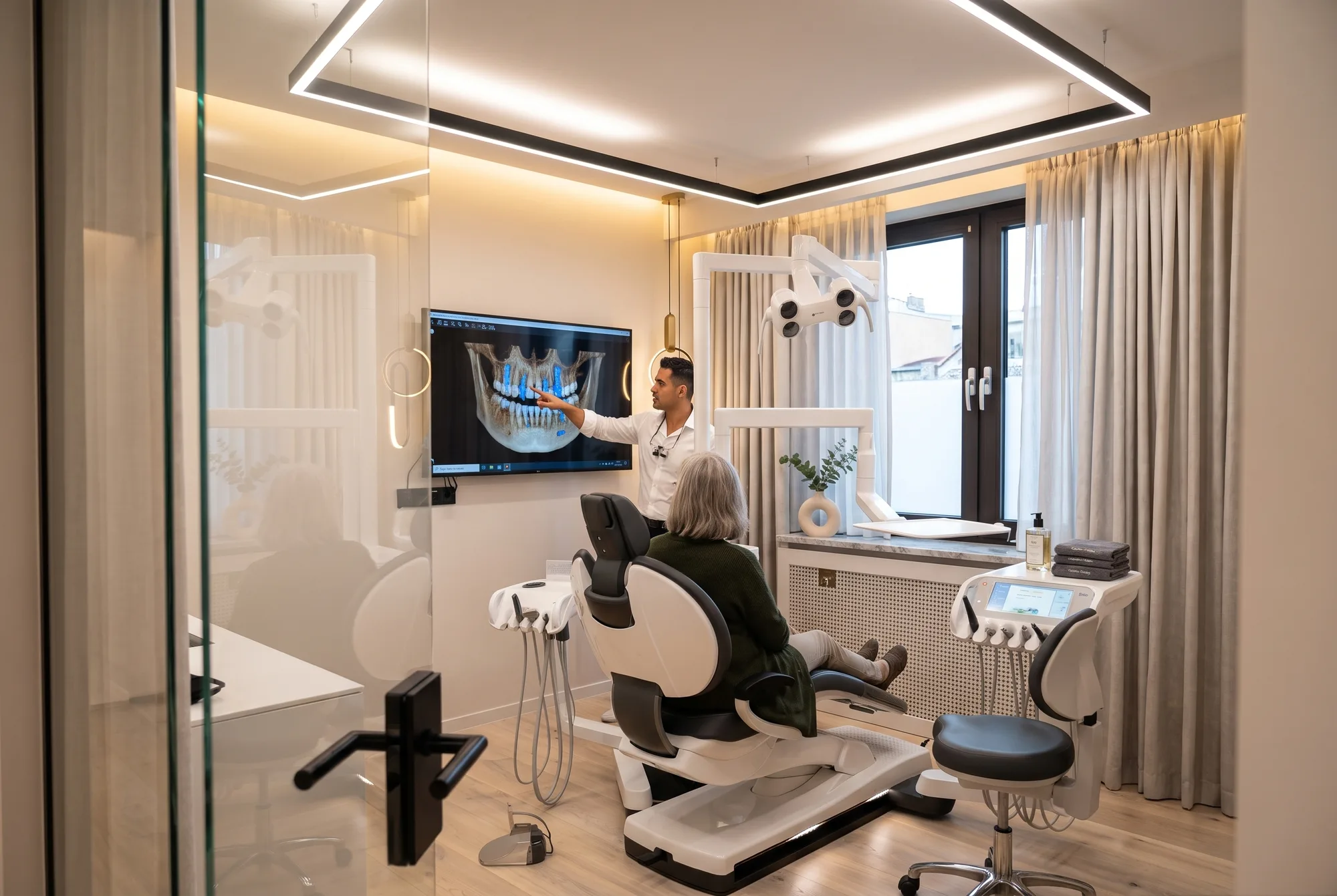
At the front, the gum has a say too.
With a front tooth in particular, the implant position is not the only thing that matters. The contour of the gum and the shape of the future crown must be planned in from the start.
That is why we plan backwards: first the future tooth, then the position of the implant.
How the 3D X-ray helpsWhat we don’t promise you.
Implant advertising promises a lot. We would rather tell you beforehand where the limits are.
If the neighbouring teeth are in great need of restoration anyway, a bridge can be the smarter solution. We show you both options openly.
Many last for decades, but only with care and check-ups. Inflammation around the implant is possible. For us, implantology doesn’t end when the crown is fitted.
If bone has been lost after a long period without the tooth, it has to be rebuilt with a graft. The 3D X-ray shows us this beforehand, not during the procedure.
In your language, with your own images on the screen, and a written plan to take home.
Your implantologist in Darmstadt: who places your implant.
Almost every dental practice offers implants today. Not every one has specific training and experience in them. So we show you openly who places implants here and where he learned to do it.
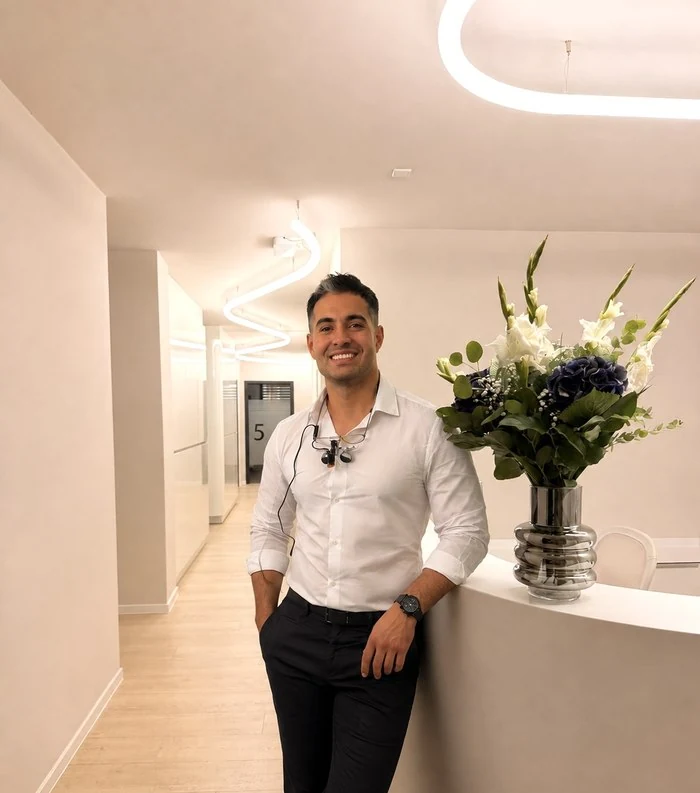
Mikael Vüsal Zeynalli, M.Sc.
“We don’t promise everyone fixed teeth in one day. First we check which concept can be planned safely. Then we talk about what you would like.”
- 2013Studied human medicine at Ruprecht-Karls-Universität Heidelberg
- 2015Studied dentistry at Heidelberg University
- 2015Licensed as a dentist
- 2015–17Associate dentist in Wiesbaden and Frankenthal
- 2018–24Dentist in Offenbach, focus on surgery and implantology
- 2020Master of Science in Oral Implantology and Surgery, Goethe University Frankfurt
- 2020Human Cadaver Course, University of Vienna: bone grafts and plastic oral surgery
- 2021“Advanced Immediate Loading” with Prof. Romanos: immediate restoration on implants
- 2021CBCT/DVT radiation protection qualification, 3D diagnostics in his own practice
- 2022Zucchelli Institute, Bologna: plastic periodontal surgery and gum reconstruction
- 2025Founded the Mensch im Mittelpunkt practice in Darmstadt
- MemberDGI, ITI and DGZMK
- LanguagesGerman, English, Russian, Turkish, Azerbaijani
Trained in Heidelberg, specialised in Frankfurt, with further training in Vienna and Bologna: implantology and surgery have been the focus of his work for more than ten years. Full career history


“He took a great deal of time to explain everything to me in detail, and it all went really well.”
Monika P. · Implant · Google“I felt they were genuinely making an effort and not just trying to get me out of the door quickly.”
J.K. · Google“What impressed me most was that he showed me my teeth with a small camera – things I would never have spotted myself as a layperson.”
Anna-Lena K. · GoogleCommon questions about single implants.
Why not simply a bridge?
For a conventional bridge, the two neighbouring teeth are ground down and crowned. If those teeth are healthy, that is a loss of tooth structure that an implant avoids. If the neighbouring teeth are in great need of restoration anyway, a bridge can be the better solution. We show you both options.
How long until the new tooth is in place?
Placing the implant takes about 45 minutes. It then heals in for two to four months. After that the crown is made. In the visible area you wear a temporary tooth in the meantime.
Does it hurt?
The procedure is pain-free thanks to the local anaesthetic. Afterwards, a mild feeling of tightness for two to three days is normal, comparable to a tooth extraction. Most patients are back at work the next day.
How long does a single implant last?
There is no fixed lifespan. Many implants work for decades, but like natural teeth they need care and regular check-ups. Inflammation of the tissue around the implant is possible, which is why aftercare is part of the treatment for us.
Can you see the implant?
Not if it is planned properly. Especially in the visible area, we pay attention not only to the implant position but also to the contour of the gum and the shape of the future crown.
What does a single implant cost?
Every situation is different, which is why we don’t quote figures online. After your consultation you receive an individual written plan with all the alternatives, explained without any rush.
I’m anxious. Can this be done under general anaesthetic?
Yes. For a single implant, a local anaesthetic is usually enough, with sedation if you wish. A general anaesthetic is possible, with an anaesthetic team in the practice.
One call. No sales pitch.
Call us and together we will find a time for your first consultation: an examination, a 3D X-ray if needed, and an honest plan with all the alternatives. What the treatment costs is something we discuss individually, in the practice.