



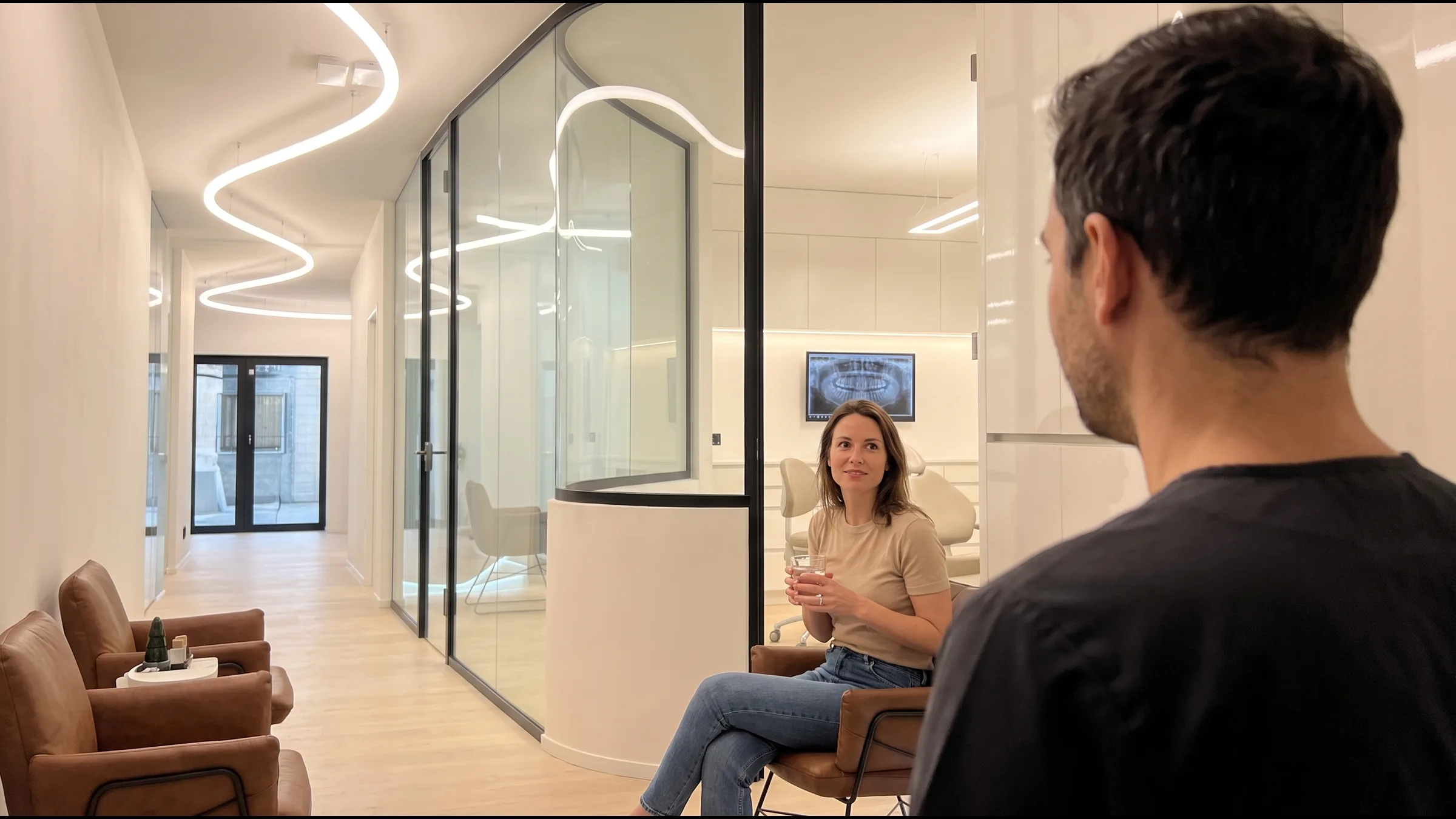
Dentist for anxious patients in DarmstadtYou don’t have to explain anything. Just call.
Years since your last dental visit, a bad experience, fear of the needle or the sound of the drill: with us, everything starts with a conversation – no treatment, no chair, no reproach. What happens next is up to you. At your pace.
Mon–Thu 8 am–6 pm · Fri 8 am–5 pm · Dieburger Straße 10, Darmstadt-Ost
Fear is not a weakness. It’s common.
And it mostly has a reason: a bad experience as a child, a dentist who didn’t listen, pain that shouldn’t have happened. The fear is the memory of it. You are not the problem.
What anxious patients describe to us is similar: the feeling of being at someone’s mercy. The sound. The needle. The shame about the state of their teeth – for most, it is greater than the fear of the treatment itself. And the sentence almost everyone says: ‘I should have come much sooner.’
We hear it often. We don’t judge it. The state of your teeth is a finding we treat – not a verdict on you.
Perhaps this sounds familiar:
- You cancel appointments or don’t make any, even though something hurts.
- Just the smell or the sound makes you uneasy.
- You sleep badly before an appointment or feel ill.
- You are ashamed to show anyone your teeth.
- You’ve had treatments that hurt even though ‘it wasn’t supposed to’.
- You take painkillers instead of calling.
Each of these is a good reason to plan the first visit differently from usual. That is exactly what we do.
A conversation. No chair, no drill.
The first visit is about getting to know each other. You tell us what you are afraid of and what went wrong in the past. We tell you how we work. Nothing more happens that day – unless you want it to.
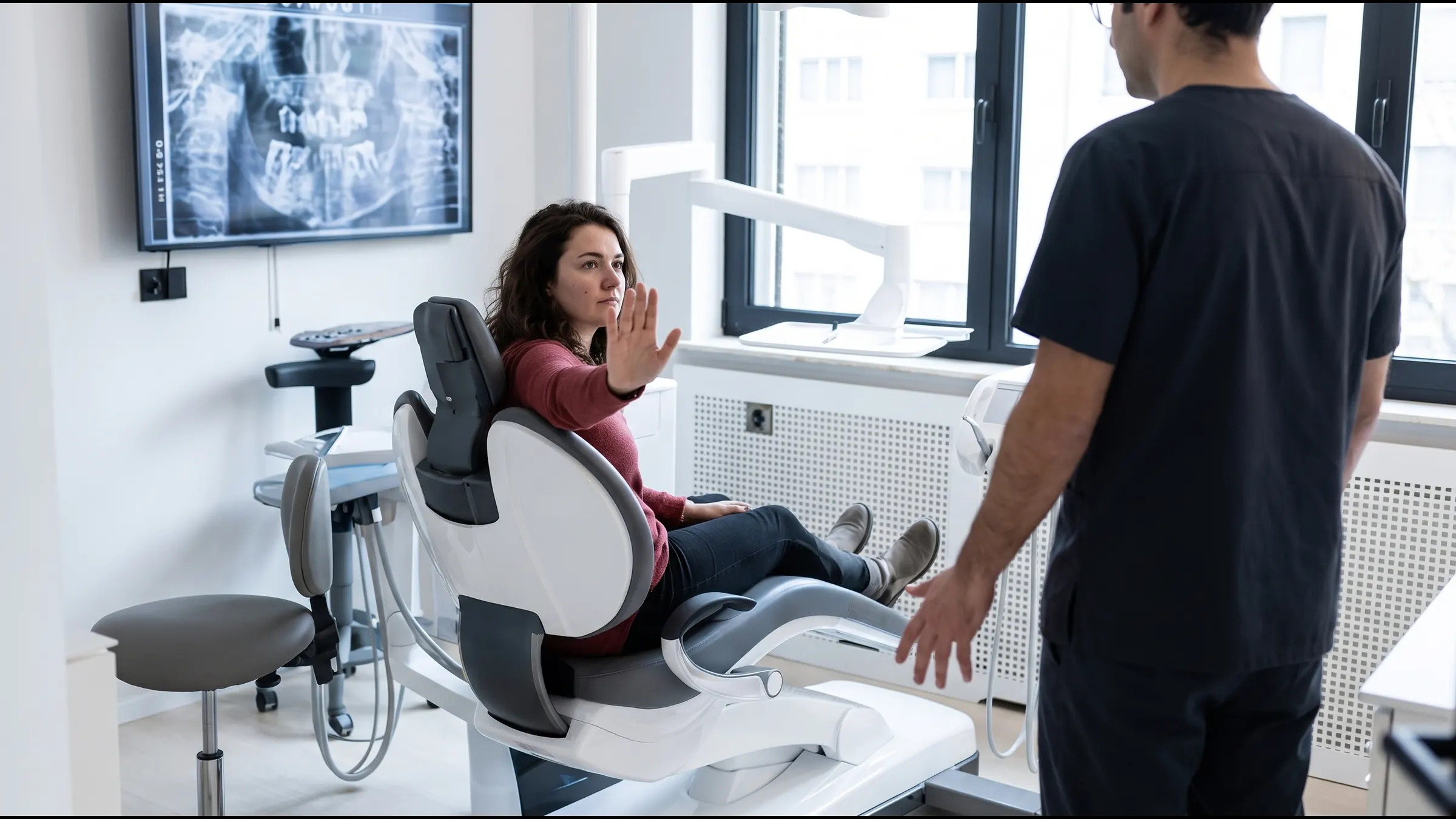
You decide how far it goes.
Time. We schedule a longer appointment so nothing is rushed. If you prefer, we sit in the consultation room, not the treatment room.
Listening. What happened before? What exactly is the fear – the needle, the sound, losing control, gagging, shame? The plan grows out of that, not out of a template.
A look only if you want. A look with the small camera is possible, but voluntary. You see on the screen what we see – no instruments, no treatment.
The stop signal. You raise your hand, we stop. Immediately, no questions asked. That applies from the first visit and at every treatment after it.
Three ways to treatment – you choose.
Which way suits you depends on how great the fear is and how much needs doing. Often it’s a combination: the start in small steps, the major restoration under general anaesthesia, the aftercare awake again.
Step by step
For everyone who wants to manage it awake – with control over every step.
- Short appointments, one goal per visit
- The start is often a teeth cleaning – nothing that hurts
- Numbing gel before every injection, given slowly
- We tell you what comes next
- Breaks whenever you need them
Suits you if the fear is great but bearable – and you want to keep the feeling of being present.
Sedation
A twilight sleep: you are deeply relaxed, breathe on your own and notice hardly anything of the treatment.
- For longer treatments in one session
- You are responsive but remember hardly anything
- Monitored throughout the treatment
- Someone to accompany you home is required
Suits you if way 1 takes too much out of you or there is a lot to do at once. Whether it is an option for you is something we clarify at the first conversation.
General anaesthesia
You sleep, an anaesthetic team monitors you, and we complete in one session what would otherwise take many visits.
- For extensive restorations and surgery
- Anaesthetic care in the practice
- Preliminary consultation with the anaesthetist
- Decided by the procedure and your health, not by wish alone
Suits you if the fear makes treatment while awake impossible. More on treatment under general anaesthesia
What we don’t promise.
Anxious patients have often heard promises that weren’t kept. So better to be plain beforehand.
Pressure, vibration, a pull when the anaesthetic goes in – that remains. What we do promise: no pain without us immediately topping up the anaesthetic. And no carrying on when you raise your hand.
It is there for the major restoration. Check-ups and teeth cleaning afterwards take place awake – and most people find that this works after the first success.
It gets smaller with every appointment that ends well. That’s why we start with something that can end well. Not with the most difficult tooth.
You know before every step what is coming. You can stop at any time. And nobody here comments on how long you’ve been away.
From the call to the first good visit.
Call or message
Tell us on the phone that you are anxious. One word is enough – we then know how to plan the appointment. If phoning is hard: WhatsApp works too.
Getting to know each other
The conversation from chapter 02. No treatment. You go home with a plan you have understood – and knowing who will treat you.
A first success
The first treatment appointment is deliberately small: a teeth cleaning, a small filling. Something that ends well. That changes more than any argument.
The actual treatment
In small steps, under sedation or under general anaesthesia – as set out in the plan. What your insurance covers and what it doesn’t, you know beforehand in writing.
Afterwards: keeping it up
Check-ups and teeth cleaning at regular intervals, so it never gets that far again. We remind you – and the appointments stay short.
You get to know your dentist before the treatment begins.
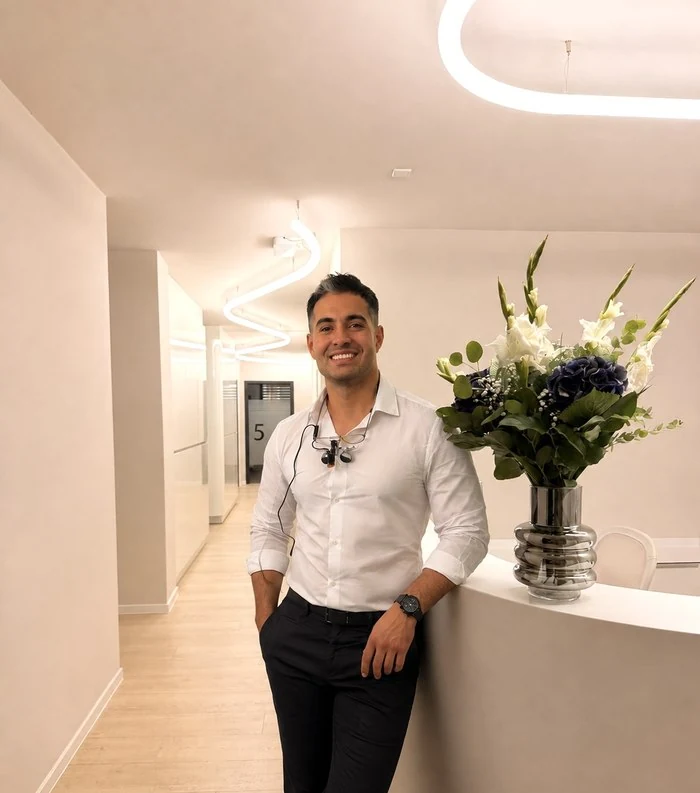
Mikael Vüsal Zeynalli, M.Sc.
“Most anxious patients are more ashamed of the state of their teeth than afraid of the treatment. Neither is an issue with us. We start where you are – and stop when you raise your hand.”
- 2015Licensed as a dentist, Heidelberg University
- 2020Master of Science in Oral Implantology and Surgery, Goethe University Frankfurt
- 2018–24Dentist in Offenbach, focus on surgery and implantology
- 2025Founded the Mensch im Mittelpunkt practice in Darmstadt
- LanguagesGerman, English, Russian, Turkish, Azerbaijani
Surgery and implantology are his focus – precisely the procedures people fear most. We treat in five languages; anyone who can explain themselves in their mother tongue is less afraid. Full career history · Our doctors
“He took a great deal of time to explain everything to me in detail, and it all went really well.”
Monika P. · Google“I felt they were genuinely making an effort and not just trying to get me out of the door quickly.”
J.K. · Google“What impressed me most was that he showed me my teeth with a small camera – things I would never have spotted myself as a layperson.”
Anna-Lena K. · GoogleWhat anxious patients ask us beforehand.
I haven’t been to the dentist for many years. Is that a problem?
No. It is the most common sentence we hear from anxious patients – and we don’t ask why. We start where you are. The state of your teeth is a finding to us, not a verdict.
Can I really just talk at the first visit?
Yes. The first visit is a conversation – in the consultation room instead of the treatment room, if you prefer. Whether we look in your mouth at all that day is up to you. There is no treatment at the first meeting.
How do I say that I need a break?
You raise your hand. We agree this before every treatment, and it applies without discussion: we stop immediately, you get time, and we only carry on when you say so.
I’m mainly afraid of the injection. What do you do about that?
The spot is numbed with a gel first, the anaesthetic is given slowly with a thin needle, and we tell you what is happening as we go. Most people feel a pressure, not a sting. If even that is too much, there is sedation.
What is the difference between sedation and general anaesthesia?
Under sedation (twilight sleep) you are deeply relaxed and notice hardly anything of the treatment, but you breathe on your own. Under general anaesthesia you sleep completely; an anaesthetic team monitors you. Both are possible for anxious patients – which one suits you, we discuss at the first conversation.
Does health insurance pay for sedation or general anaesthesia for dental anxiety?
Statutory health insurance (GKV) covers general anaesthesia only where there is a medical justification; pronounced dental anxiety can be one, but does not have to be. Sedation is usually a private service. What you will have to pay is set out in writing before the treatment.
Can someone come with me?
Yes. A companion may sit in on the conversation and – if space allows – on the treatment too. After sedation or general anaesthesia a companion is compulsory anyway, because you are not allowed to drive that day.
What happens if I panic in the chair?
Then we stop, sit the chair up and let you settle. That is not a failure – it is the reason we work in small steps. The next step is then planned smaller – or with sedation.
My child is afraid of the dentist. Does this apply to children too?
Yes, with different means. How the first visit works for children is explained on our children’s page.
One call. Nothing more.
Say ‘I’m afraid of the dentist’ – we take care of the rest. You get an appointment to meet us, without treatment. If phoning is hard, write to us.
Opening hours & contact
Appointments by arrangement
Parking: REWE car park, Spilwesweg 1 – two minutes on foot.